Available in: Norsk
Enterprise Architecture Without Central Control. Is It Possible?
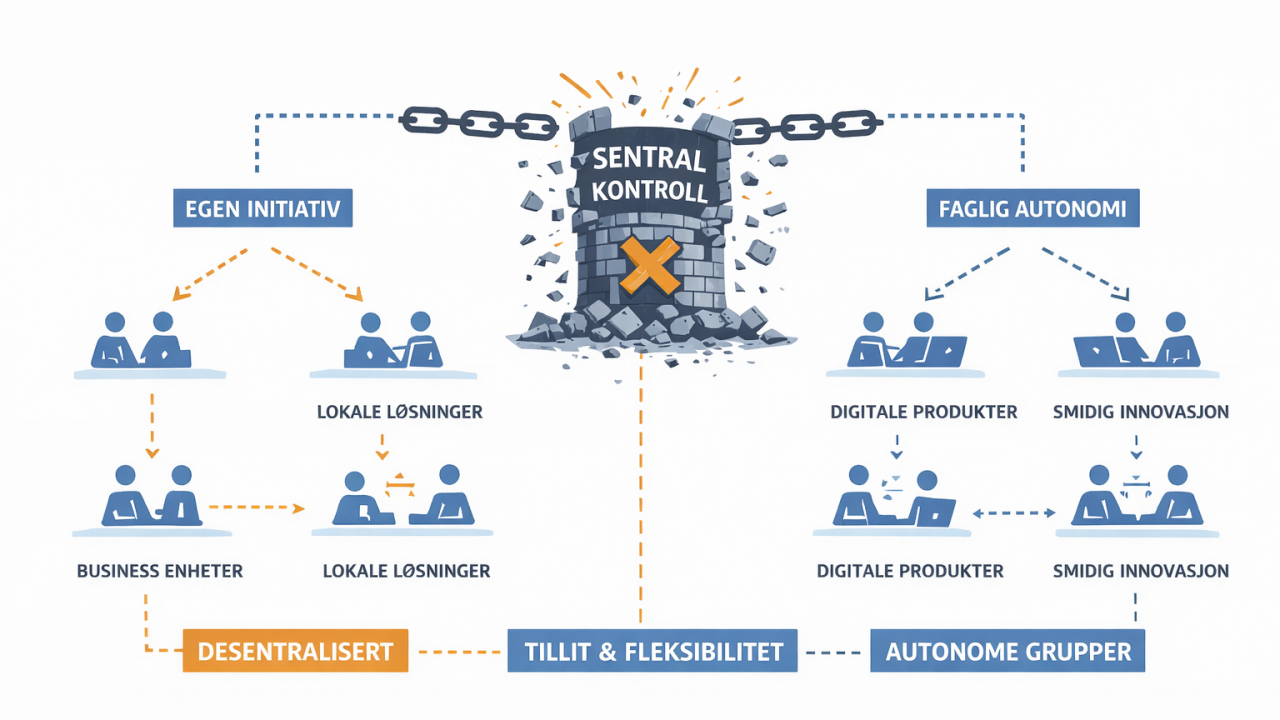
Enterprise architecture is often associated with centralization: shared standards, shared guidelines, and centralized roadmaps. And for a long time, that worked.
In my work as an enterprise architect at Uno-X, and in parallel as a domain architect on a group-wide platform at Reitan, I've found myself in the middle of quite different, and at times opposing, challenges. In one context, it's about creating more coherence among highly autonomous teams. In another, it's about gradually building more autonomy where governance has historically been stronger. Yet the underlying issue is the same in both places: architecture is less about structure and more about decisions, ownership, and clarity. That raises an unavoidable question:
Is Enterprise Architecture Possible Without Central Control?
I've watched enterprise architecture fail many times. Rarely because the architecture itself was wrong, but because it was built on assumptions that no longer matched reality. One of those assumptions is that architectural coherence requires central control. In practice, I've experienced something different.
As organizations scale across more teams, domains, and products, central control becomes increasingly difficult to maintain. The architecture doesn't disappear, but it loses its effectiveness if it was built for a reality that no longer exists. What follows is often a familiar pattern: some teams get pushed toward more autonomy than they're actually ready for, while others experience the opposite, constraints so tight that local ownership becomes hard to exercise. The enterprise architect ends up caught in the middle, trying to coordinate without becoming a bottleneck.
That's when architecture discussions often turn ideological: centralization versus autonomy, control versus speed. In my experience, that's the wrong framing. The question isn't whether enterprise architecture can work without central control. The question is what kind of control is actually necessary. Architecture doesn't need centralized solutions to exist. What it needs is shared clarity.
Decision Space Over Micromanagement
In decentralized organizations, architecture is less about defining solutions and more about defining decision space. That means being explicit about:
- which decisions must be made centrally
- which decisions belong to the teams
- where the boundaries actually sit
When this stays unclear, the gap gets filled quickly, not out of ill will, but out of the need to keep moving. Over time, that can create fragmentation that looks like freedom but is, in practice, growing complexity.
Enterprise architecture tends to fail here not by being too strict, but by being too implicit. Principles exist. Intentions exist. Diagrams exist. But the consequences of the choices remain unclear. Teams are told they're autonomous, only to later discover that their decisions have consequences far beyond their own area. That isn't autonomy. That's uncertainty.
From Control to Clarity
What I've learned is that enterprise architecture works best when the focus shifts:
From enforcing standards and approving solutions.
To clarifying ownership, making consequences visible, and keeping decisions understandable over time.
Central control scales poorly. Shared understanding doesn't. When teams know which choices actually affect others, they can move faster, not slower.
When Control Isn't the Goal
This has made one thing clear to me: enterprise architecture isn't about reclaiming control, it's about making decisions clear enough to hold up in the absence of control. Maybe the enterprise architect's most important job is no longer to design the whole alone, but to make sure the whole can actually emerge.
In highly autonomous organizations, that means being explicit about ownership, decisions, and consequences, rather than centralizing the solutions themselves. When architecture leads to fewer surprises and more deliberate choices across the organization, it's doing its job, even without central control. In some contexts, that also means being willing to hand off control gradually, and in others, taking it back where autonomy has outrun accountability.
Share this article
Related articles
When Everything Is Shared, Nobody Owns It
Many organizations are not slowed down by a lack of capability. They are slowed down by unclear ownership.
The Urgency Trap
Many organizations are not slowed down by resistance. They are slowed down by competent people solving the right problems at the wrong time.
When Organization and Architecture Must Align
Reflections on why architecture, product organization and governance models must evolve together to create real autonomy and lasting impact.